

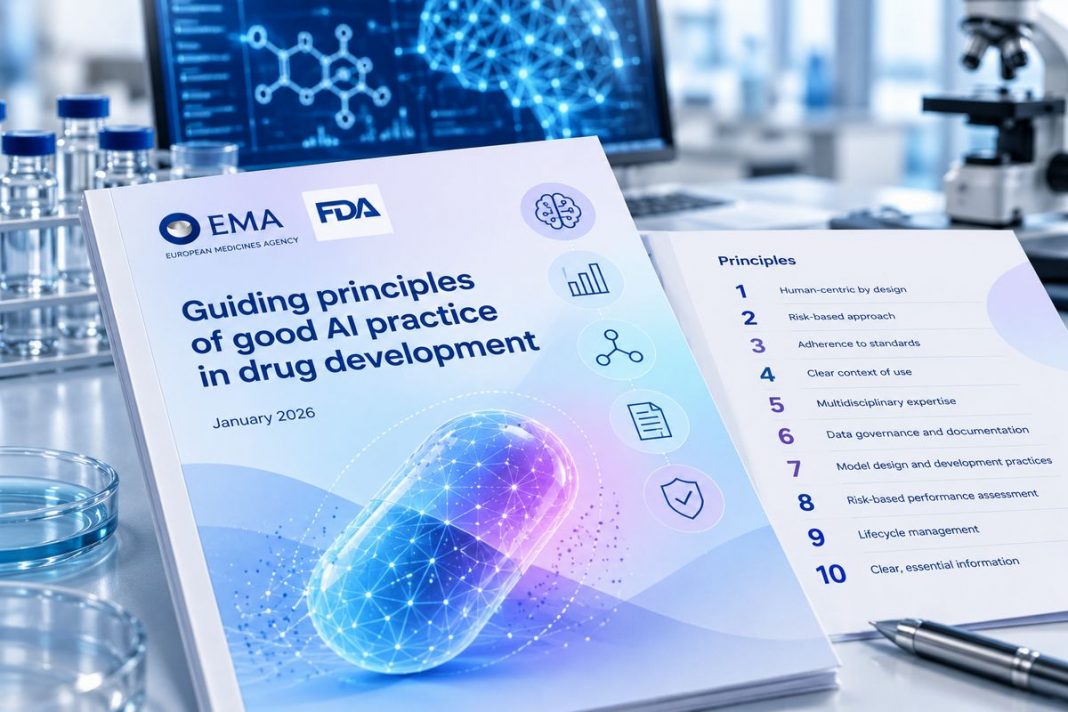
The European Medicines Agency (EMA) and the U.S. Food and Drug Administration (FDA) have jointly developed Guiding principles of good AI practice in drug development (January 2026). The Document sets out ten principles for the responsible use of artificial intelligence (AI) in generating and analysing evidence throughout the medicines lifecycle. This overview examines the principles and their implications for data governance, risk-based validation, model performance assessment and lifecycle oversight.
A common framework for AI across the medicines lifecycle
AI technologies are increasingly being used to generate and analyse evidence throughout the drug product lifecycle, from nonclinical research and clinical development to manufacturing and post-marketing safety monitoring. Their applications may support the prediction of toxicity and efficacy, improve pharmacovigilance and help reduce reliance on animal testing.
However, the use of AI in regulated pharmaceutical activities introduces specific challenges. Model outputs depend on the suitability of the underlying data, the design of the system and the context in which it is deployed. Performance may also change over time as data and operating conditions evolve.
The EMA and FDA developed ten common principles to address these challenges and encourage good practice across the medicines lifecycle. The principles apply to system-level AI technologies used to generate or analyse evidence in nonclinical, clinical, manufacturing and post-marketing activities. They are relevant to both human and veterinary medicines.
The document is intended to support collaboration between regulators, standards organisations and other stakeholders. It is a non-binding framework for developing good practice, not a new regulation or a replacement for existing legal and GxP requirements. AI-generated evidence must continue to meet the applicable requirements for medicine quality, safety and efficacy.
The ten guiding principles
1. Human-centric by design
AI technologies should be developed and used in accordance with ethical and human-centric values. Their design and implementation should consider the people affected by the technology, including patients and healthcare professionals, as well as the potential consequences of its use in the relevant pharmaceutical context.
2. Risk-based approach
Validation, risk mitigation and oversight should be proportionate to the context of use and the assessed risk associated with the model. The intended application, the significance of the evidence generated and the potential consequences of an incorrect output should inform the level of control required.
3. Adherence to standards
AI technologies should comply with relevant legal, ethical, technical, scientific, cybersecurity and regulatory standards, including applicable Good Practice requirements (GxP). Existing regulatory obligations remain applicable when AI is introduced into pharmaceutical activities.
4. Clear context of use
The role and scope of an AI technology should be clearly defined. A well-defined context of use establishes what the system is intended to do, how its outputs will be used and which requirements apply to its development, validation, performance assessment and oversight.
5. Multidisciplinary expertise
Expertise in both AI technology and its intended application should be integrated throughout the technology’s lifecycle. This requires collaboration between technical specialists and professionals with relevant scientific, clinical, manufacturing and regulatory knowledge.
6. Data governance and documentation
Data provenance, processing steps and analytical decisions should be documented in a detailed, traceable and verifiable manner, in line with GxP requirements. Appropriate governance, including the privacy and protection of sensitive data, should be maintained throughout the technology’s lifecycle. Documentation should make it possible to understand how evidence was generated, identify the data and methods involved, and review the decisions taken during data processing and analysis.
7. Model design and development practices
AI technologies should be developed using good practices in model and system design and software engineering. The data used should be fit for the intended purpose, while model development should consider interpretability, explainability and predictive performance. Transparency, reliability, generalisability and robustness are important considerations in determining whether a model is suitable for its intended application.
8. Risk-based performance assessment
Performance assessments should evaluate the complete system, including interactions between people and AI. They should use data suitable for the intended purpose and metrics appropriate to the context of use, supported by appropriately designed testing and evaluation methods to validate predictive performance. Assessment should therefore consider not only the model in isolation, but also how users interact with it and how its outputs influence decisions.
9. Life cycle management
Risk-based quality management systems should be implemented throughout the lifecycle of AI technologies. These systems should support the capture, assessment and resolution of issues. AI technologies should also undergo scheduled monitoring and periodic re-evaluation to ensure that performance remains adequate. Data drift and changes in operating conditions are examples of issues that may affect performance and require further assessment or corrective action.
10. Clear, essential information
Information about AI technologies should be presented in plain language and tailored to the intended audience, including users and patients. It should address the technology’s context of use, performance, limitations, underlying data, updates and interpretability or explainability, as relevant. The objective is to ensure that relevant stakeholders understand what the system can and cannot do and can interpret its outputs appropriately.
Implications for pharmaceutical quality and compliance
Taken together, the ten principles provide a framework covering the main stages of AI governance: defining the intended use, applying proportionate controls, ensuring data traceability, developing and evaluating models, monitoring performance and communicating relevant information.
Several principles have a direct connection with established pharmaceutical quality practices. These include adherence to GxP requirements, documented and traceable data processing, risk-based validation, quality management and continued monitoring. Their application to AI requires controls that reflect the specific technology, its intended purpose and the potential impact of its outputs.
The principles also underline that technical performance alone is insufficient. Pharmaceutical organisations need multidisciplinary oversight to assess whether AI-generated evidence is scientifically appropriate, reliable and suitable for the decisions it is intended to support.
International alignment and further regulatory work
The FDA and EMA describe the principles as a foundation for developing good practice and identifying areas for international cooperation. Potential areas of collaboration include research, educational resources, international harmonisation and consensus standards that may inform regulatory policies and guidance in different jurisdictions.
In the EU, further AI guidance is being developed, building on EMA’s 2024 reflection paper on the use of AI in the medicinal product lifecycle. The ten principles should therefore be read alongside applicable legislation and more specific guidance relevant to individual applications.
As AI technologies evolve, the principles and supporting standards will also need to develop. For pharmaceutical companies and other organisations using AI to generate or analyse evidence, the framework brings together human-centric design, risk management, data governance, performance assessment and lifecycle oversight as complementary elements of responsible implementation.
Official source document
Get the full text of the EMA & FDA Guidelines: Guiding Principles of Good AI Practice in Drug Development (2026), including QMS requirements and details on the risk-based approach, in our Resource Center.
