

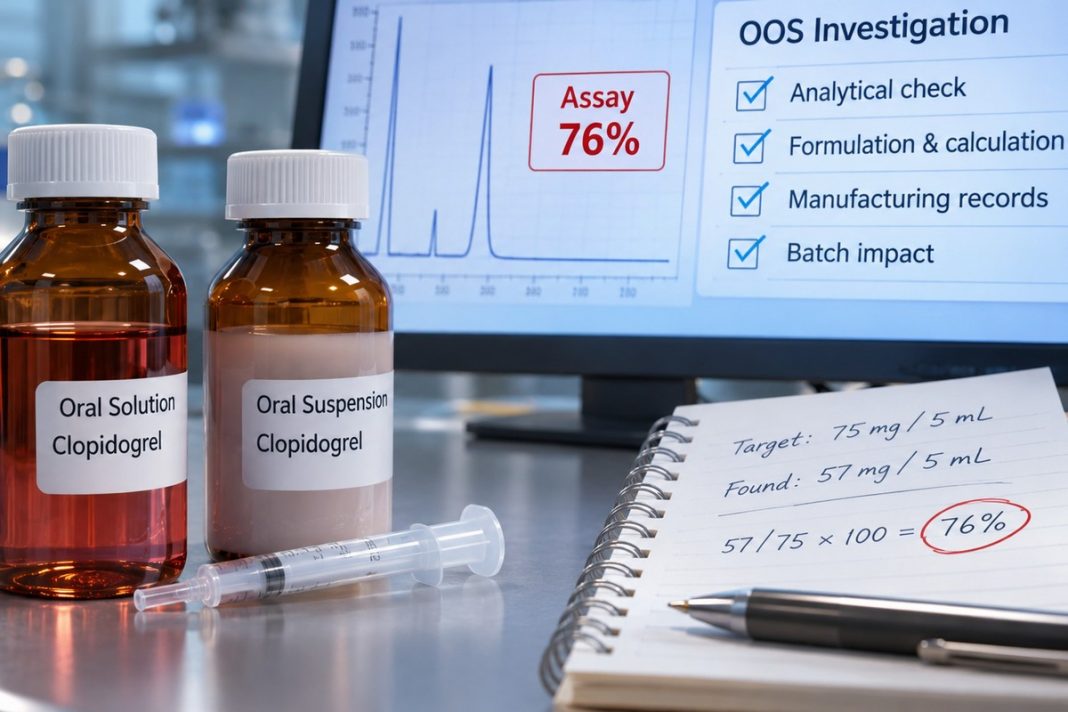
The UK Medicines and Healthcare products Regulatory Agency (MHRA) has issued a Class 2 recall covering all strengths and all batches of Xeal Pharma’s clopidogrel oral solutions and suspensions manufactured before the recall notification. A formulation error resulted in the affected products containing 76% of the required amount of active ingredient. The case highlights three critical quality challenges: control of active substance content in liquid dosage forms, investigation of out-of-specification (OOS) results, and scientifically justified assessment of the full batch impact.
1. The recall: what is established
In its notice of 26 October 2026, MHRA reported that Xeal Pharma’s Clopidogrel Oral Solution and Clopidogrel Oral Suspension contained less clopidogrel than labelled because of a formulation error. The affected products are unlicensed medicines supplied under MS 46688 and contain clopidogrel hydrogen sulfate as the active ingredient. The reported content was 76% of the required amount, representing a 24% shortfall against the intended strength. The recall covers all batches manufactured before the notification and applies at patient, pharmacy and wholesaler level.
The affected presentations are:
- 1 mg/ml oral suspension;
- 25 mg/5 ml oral solution and oral suspension;
- 75 mg/5 ml oral solution and oral suspension.
The notice identifies a formulation error as the cause but does not disclose the detailed investigation report, the analytical method, individual batch assay results or the precise calculation that produced the under-strength formulation. These limitations are important when interpreting the incident from a pharmaceutical quality perspective.
2. Assay control in oral solutions and suspensions
Assay testing determines the amount of active pharmaceutical ingredient (API) present in a sample of the finished product. For a liquid medicine, the result must be interpreted against the intended concentration and the applicable product specification, taking account of the analytical method and sample preparation. A reported content of 76% of the required amount indicates a substantial shortfall. However, the numerical result alone does not establish the mechanism responsible for it.
A quality investigation must distinguish between a genuine formulation or manufacturing defect and an error introduced during sampling, sample preparation, analytical measurement or calculation.
Formulation calculations
The quantitative basis of the formulation should be checked against the intended labelled strength, batch size, final volume and quantity of active ingredient required. Where the API is introduced as a salt, the calculation should also account for the correct relationship between the salt and the declared active moiety, where applicable, as well as the relevant raw material assay or potency basis.
These are potential investigation points, not established explanations for the Xeal Pharma incident.
Analytical method and result calculations
Investigators should verify the suitability of the method, reference standard, sample preparation, dilution factors, calculation formulas and reporting units. Relevant laboratory records should be reviewed to determine whether the reported result accurately reflects the amount of API in the product.
An analytical error should not be assumed simply because the result is unexpected; nor should a result be invalidated without scientifically justified evidence.
Solutions and suspensions
Although both dosage forms require reliable control of API content, their physical characteristics affect how samples should be taken and prepared.
For a solution, the investigation may examine concentration calculations, final volume and the possibility of precipitation or other changes affecting the sampled material. For a suspension, sample representativeness, redispersion, settling and dose withdrawal can be particularly important when assessing whether the material is sufficiently uniform.
These considerations do not demonstrate that Xeal Pharma experienced a sampling, mixing, precipitation or analytical problem. The public notice does not provide the data needed to make that determination.
3. OOS investigation: from result confirmation to root cause
An out-of-specification result requires a documented, scientifically justified investigation. The objective is not simply to repeat the test, but to establish whether the result is valid, determine the root cause where possible, define the extent of the affected product and identify appropriate corrective and preventive actions (CAPA).
For an under-strength liquid medicine, the investigation can be structured around four areas:
Analytical assessment
- Review the original chromatograms, calculations, instrument records and relevant laboratory documentation, where applicable to the method.
- Verify sample preparation, dilution factors, reference standard use and calculation formulas.
- Assess whether the sample was representative of the product, including any relevant requirements for redispersion before sampling a suspension.
- Determine whether there is documented evidence of a laboratory error or another scientifically justified explanation for the result.
Formulation and manufacturing records
- Compare the intended product strength with the formulation and master manufacturing instructions.
- Recalculate the required API quantity, accounting for the applicable raw material potency basis and any relevant salt-to-active-moiety conversion.
- Review dispensing and weighing records, batch size calculations, final volume adjustments and relevant in-process controls.
- Compare the formulation basis and manufacturing instructions across the affected strengths and dosage forms to identify any common calculation or documentation error.
Historical results and extent of the problem
- Review available finished-product assay results and related quality records for historical batches.
- Determine whether the deviation is consistent across batches, strengths and dosage forms, or whether material differences require separate investigation.
- Examine relevant complaints, deviations, changes and previous investigation records.
- Assess whether other products or batches could share the same formulation basis, calculation method or manufacturing instructions.
Root cause and CAPA
- Distinguish the immediate cause of the under-strength result from the underlying process failure that allowed it to occur.
- If a formulation calculation is confirmed as the root cause, address the affected calculations and documentation through appropriate corrective measures.
- Consider preventive controls proportionate to the identified failure mechanism, such as independent verification of critical formulation calculations, controlled updates to master manufacturing instructions and documented review of the corrected formulation before further manufacture.
- Assess and document the effectiveness of the implemented corrective and preventive actions.
These are examples of measures that may be appropriate depending on the findings; they are not a description of CAPA already implemented by Xeal Pharma.
MHRA confirms that Xeal Pharma attributed the incident to a formulation error and stated that future stock would be manufactured using the correct strength and calculations. The public notice does not provide enough information to assess the detailed root cause analysis or the effectiveness of the company’s preventive controls.
4. Batch impact assessment: why the scope matters
Defining the affected product population is a separate task from identifying the root cause. A quality investigation must establish which batches may have been manufactured under the defective conditions and whether the same failure mechanism could affect other strengths, presentations or products.
In the Xeal Pharma case, MHRA states that all batches produced before the notification are affected. The recall therefore extends beyond a single isolated batch to the pre-notification production of all listed strengths of both oral solutions and suspensions.
For quality professionals, this scope raises several important questions:
- Common formulation basis: Were the affected products manufactured using shared formulation calculations, master records or development assumptions?
- Chronological boundaries: Can the start and end of the affected production period be established from controlled records, including relevant formulation changes and corrective actions?
- Cross-product assessment: Could the same calculation or documentation defect affect other strengths or dosage forms that use the same active ingredient and formulation basis?
- Evidence supporting exclusions: If any batch or presentation is considered unaffected, what documented scientific evidence supports that conclusion?
The notice provides a list of affected batch numbers in its annex. However, the public information does not include the full batch-by-batch assay dataset or explain how the manufacturer established the detailed boundaries of the defect. It is therefore not possible to independently reconstruct the complete batch impact assessment from the recall notice alone.
5. Interpreting the 76% result across liquid dosage forms
A common under-strength result across multiple strengths can be consistent with a shared formulation or calculation problem. Nevertheless, the reported percentage should not be treated as proof of a particular mathematical error or as evidence that every individual container and dose had identical API content.
For solutions, investigators would examine whether the concentration deficit is consistent with the formulation calculations and available batch results. For suspensions, they would also need to consider whether the analytical sampling approach adequately represents the product and whether any dose-to-dose variation is relevant to the observed findings.
Distinguishing a systematic concentration deficit from variability within a batch requires appropriate analytical and manufacturing evidence. Useful information would include individual batch assay results, the sampling plan, relevant method-performance data and, where necessary, evidence relating to dose uniformity or suspension homogeneity.
MHRA’s public notice reports the overall finding of 76% of the required clopidogrel content. It does not publish the underlying measurements needed to determine the distribution of results within or between batches. The extent of any additional variability therefore remains unestablished in the public record.
6. Patient risk and recall execution
According to the manufacturer’s risk assessment cited by MHRA, patient harm is not anticipated in people receiving the affected products for long-term preventive treatment. However, patients would not have received their full prescribed dose, and no reports of patient harm had been received at the time of the notice.
The recall requires healthcare professionals to stop supplying the affected batches, quarantine remaining stock and return it through the supplier’s approved process. Pharmacists must identify and contact patients who received affected batches. Where batch traceability information is unavailable, all patients dispensed the product from 20 July 2026 must be contacted.
Prescribers and other healthcare professionals must review ongoing treatment with affected patients. MHRA warns that patients should not abruptly stop taking clopidogrel without medical advice because sudden discontinuation may cause serious thrombotic events.
Since no licensed clopidogrel oral solutions or suspensions are available in the UK, individual patients may require a dose correction, an alternative licensed formulation or a different treatment option.
The patient-level recall also demonstrates why batch traceability is integral to effective quality risk management. When the affected batch cannot be identified at the point of dispensing, the scope of patient contact may need to be widened to ensure that potentially affected individuals are not missed.
7. What the case demonstrates for pharmaceutical quality teams
The Xeal Pharma recall illustrates the connection between formulation design, calculation verification, analytical control and batch impact assessment. A defect attributed to formulation can affect multiple strengths and batches, making it essential to investigate both the immediate quality result and the processes that define the intended product strength.
Three practical principles emerge from the case:
- Verify the quantitative basis of the formulation: The intended strength must be correctly reflected in formulation calculations, controlled manufacturing instructions and relevant quality-control calculations.
- Investigate OOS results systematically: Analytical, formulation and manufacturing evidence should be assessed together, without assuming a laboratory error or a particular manufacturing mechanism before the evidence supports it.
- Establish the full scope of affected product: Batch boundaries, related strengths and dosage forms, traceability and the evidence supporting any exclusions must be assessed and documented.
The recall establishes that a formulation error led to clopidogrel oral liquids containing less than the required amount of active ingredient and that all pre-notification batches were included in the action. The public notice does not disclose the full investigation record, so more specific conclusions about the underlying calculation, release-testing controls or detailed CAPA would require additional evidence.
For pharmaceutical quality professionals, the central lesson is the need to connect accurate formulation calculations with reliable assay control, scientifically justified OOS investigations and a documented assessment of the entire potentially affected product population.
