

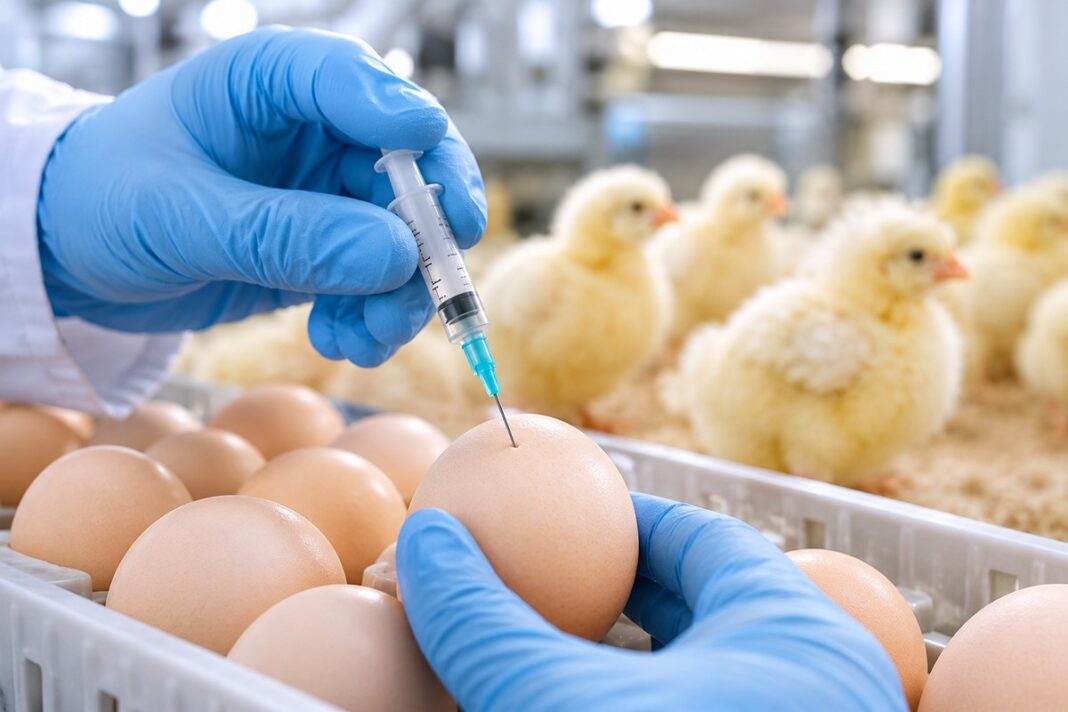
An in ovo immune-complex vaccine protected broiler chickens against clinical disease, acute bursal lesions and growth impairment following challenge with a heterologous very virulent infectious bursal disease virus (vvIBDV) strain, according to a study published in Vaccines.
The study, conducted by researchers from HIPRA S.A., evaluated the efficacy of an immune-complex vaccine containing live attenuated IBDV strain 1052 and egg-derived IgY antibodies. The findings also highlight the importance of distinguishing vaccine-associated changes in the bursa of Fabricius from acute pathological damage caused by virulent infection.
Study design
Commercial broiler eggs were vaccinated in ovo at 18 days of incubation. The vaccine was administered into the amnion. At 24 days of age, ten birds from each treatment group were euthanised to assess vaccine-associated changes. The remaining birds were divided into vaccinated and unvaccinated subgroups, which were subsequently either challenged or left unchallenged.
The challenge was performed using the heterologous very virulent IBDV strain VG-248, administered at a dose of 105 EID50 per bird. The strain was genetically related to other European vvIBDV strains, including UK661, CS89 and 74-89A.
Clinical observations, body-weight gain, organ-weight ratios, macroscopic lesions and histopathological changes were assessed six days after challenge.
Protection against clinical disease and growth impairment
No clinical signs were observed in vaccinated birds following challenge. In the unvaccinated challenged group, 5 of 10 birds developed mild clinical signs, including depression and ruffled feathers. No mortality occurred in any group.
Body-weight gain between days 23 and 30 was significantly higher in vaccinated challenged birds than in unvaccinated challenged controls:
- Vaccinated and challenged: 541.38 ± 67.10 g
- Unvaccinated and challenged: 339.85 ± 59.35 g
The growth performance of vaccinated challenged birds was comparable to that of non-challenged controls. The difference between challenged vaccinated and unvaccinated groups was statistically significant (p = 4.36 × 10⁻⁶).
Reduced bursal and spleen pathology
Unvaccinated challenged birds developed pronounced macroscopic bursal lesions, including swelling, petechiae, haemorrhages, inflammation and gelatinous serosal oedema.
The bursa-to-body-weight ratio was significantly higher in unvaccinated challenged birds than in vaccinated challenged birds:
- Unvaccinated and challenged: 4.26 ± 2.95
- Vaccinated and challenged: 0.95 ± 0.30
The difference was statistically significant (p = 1.92 × 10⁻⁶).
The spleen-to-body-weight ratio was also significantly elevated in unvaccinated challenged birds, reaching 1.61 ± 0.21, compared with 1.00 ± 0.37 in vaccinated challenged birds and 0.88 ± 0.16 in non-challenged controls (p = 0.0003).
Histopathological differences between vaccination and infection
Microscopic examination revealed distinct patterns of tissue changes.
Unvaccinated challenged birds showed marked inflammatory infiltration, oedema affecting the bursal folds, muscular wall and serosa, and lymphoid necrosis.
Vaccinated birds, including those subsequently challenged, showed lymphoid depletion and bursal fold atrophy associated with vaccine-virus replication. However, these changes were accompanied by minimal inflammatory infiltration, absence of oedema, low necrosis scores and evidence of early lymphoid repopulation.
The researchers noted that lymphoid depletion alone cannot reliably distinguish expected vaccine-associated changes from acute damage caused by vvIBDV infection. They therefore assessed inflammatory, oedematous, necrotic and regenerative alterations independently.
Implications for vaccine efficacy assessment
The study demonstrates the protective efficacy of in ovo immune-complex vaccination against the clinical and acute pathological consequences of heterologous vvIBDV challenge under experimental conditions.
The authors suggest that assessing inflammation, oedema, necrosis and tissue regeneration alongside lymphoid depletion may provide a more informative framework for evaluating vaccine-associated bursal changes and protection against infectious bursal disease. However, the findings are limited by the relatively small sample size and short observation period. The study did not assess viral replication, antibody responses or the duration of immunity, and therefore does not establish the vaccine’s effects on these parameters or on longer-term production performance.
