

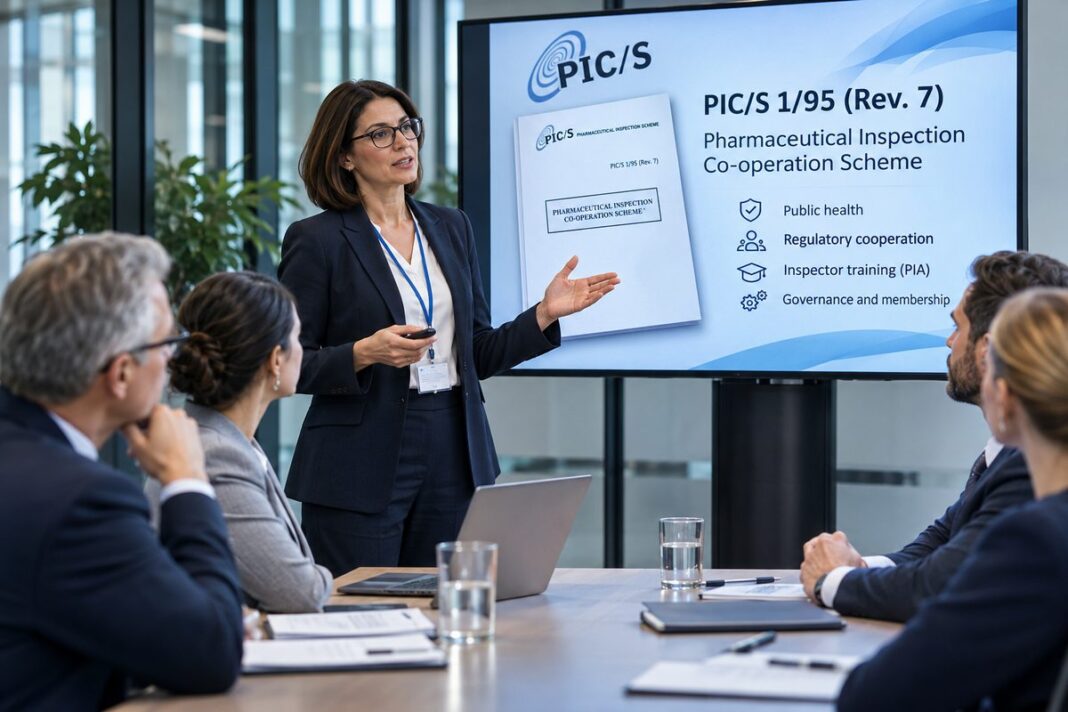
The Pharmaceutical Inspection Co-operation Scheme (PIC/S) has adopted Revision 7 of its foundational document, PIC/S 1/95, introducing updates to its governance, membership framework, inspector training and international regulatory cooperation. The revised Scheme was adopted by the PIC/S Committee in Istanbul, Türkiye, on 2 November 2026 and entered into force on the same date. PIC/S announced the revision on 12 November.
PIC/S remains a legally non-binding cooperation framework
The revised Scheme confirms PIC/S’s status as a non-profit association established under Articles 60 and following of the Swiss Civil Code and registered in Geneva, Switzerland. Although international in its membership and activities, PIC/S does not have the legal status of an intergovernmental organisation under public international law. The Scheme is a legally non-binding arrangement between regulatory authorities and other bodies representing them that are competent to inspect medicinal products in the field of Good Manufacturing Practice (GMP).
The document also confirms the organisation’s scientific and technical character and its non-political and non-discriminatory principles. All members have equal rights and obligations, and English remains the working language. The Scheme covers medicinal products for human and veterinary use, as well as active pharmaceutical ingredients (APIs) and excipients used in their manufacture.
Public health and inspection reliance become more prominent
Revision 7 places the protection of public health explicitly at the centre of PIC/S’s mission. It reinforces cooperation between participating authorities, mutual confidence, GMP inspection reliance and global regulatory convergence, as well as collaboration with international regulatory and harmonisation bodies.
The revised mission describes PIC/S’s role in developing, implementing and maintaining harmonised GMP standards and quality management systems for inspectorates. These activities are intended to support consistent inspections and cooperation in the oversight of pharmaceutical manufacturing.
Participating Organisations recognised as a membership category
The revised Scheme introduces Participating Organisations (POs) as a distinct membership category alongside Participating Authorities (PAs). A Participating Organisation is an organisation other than a Regulatory Authority that conducts inspections on a legislative basis, has applied for PIC/S membership, meets the applicable specific requirements and has acceded to the Scheme.
The document also clarifies that references to Participating Authorities generally include Participating Organisations unless the text expressly provides otherwise. The change formalises the participation of eligible inspection bodies that do not fall within the conventional category of medicines regulatory authorities.
PIC/S Inspectorates’ Academy and knowledge transfer
Revision 7 reinforces the role of the PIC/S Inspectorates’ Academy (PIA) in the organisation’s mission and objectives. The Academy promotes harmonised training, supports consistent inspector qualification processes and contributes to inspection excellence across participating authorities.
The Scheme also highlights structured knowledge transfer, continuity, capacity building and the preservation of institutional knowledge within inspectorates. These provisions are intended to support the development and maintenance of inspection expertise across the PIC/S network.
Governance and financial oversight updated
The revised document clarifies the responsibilities and oversight arrangements of the three principal PIC/S bodies: the PIC/S Committee, the Executive Bureau and the Secretariat. The Committee oversees the organisation’s overall operation, adopts annual budgets, approves financial accounts and decides on membership matters. The Executive Bureau implements Committee decisions and oversees strategy, resources and organisational management. The Secretariat supports the implementation of PIC/S’s mission and is managed by the Directorate.
Revision 7 also updates financial accountability provisions in line with applicable Swiss law. Regular audits by an auditing body are required if PIC/S exceeds two of the following three thresholds during two consecutive financial years: a total balance sheet of CHF 10 million, annual turnover of CHF 20 million, or an average workforce of 50 full-time employees.
Membership suspension and exclusion provisions clarified
The Scheme specifies circumstances in which a Participating Authority may be suspended or excluded. These include failure to maintain membership requirements, non-compliance with obligations such as participation in meetings or payment of financial contributions, and conduct that undermines PIC/S’s proper functioning, objectives or reputation.
Depending on the circumstances, the Committee may suspend participation for a specified period, extend the suspension or proceed with immediate exclusion. Representatives of Participating Authorities may also be suspended or excluded for conduct incompatible with PIC/S principles, including breaches of the rules of conducts or the principles of non-politicisation and non-discrimination.
Information sharing remains voluntary
Chapter X establishes the framework for sharing confidential information between participating authorities. Information sharing is fully voluntary, and no authority is required to provide information to another member. The purpose is to support each authority’s risk management when deciding whether a manufacturing site should be inspected under GMP inspection reliance arrangements.
Subject to applicable legal requirements, authorities may share information such as GMP compliance status, inspection reports, corrective action plans, company inspection plans, correspondence and follow-up information. Information received from another authority is not binding. Each authority remains responsible for evaluating and using the information, and is not obliged to accept another member’s conclusions.
The Scheme also identifies information that must not be shared, including financial and commercial data, technical know-how and trade secrets, research information, personal data unrelated to official duties, and information concerning official investigations where disclosure could jeopardise enforcement activities. Participating Authorities and their employees are required to respect the confidentiality of information shared within PIC/S.
Immediate communication of serious public health threats
Chapter XI addresses rapid alerts and recalls arising from quality defects. If a Participating Authority identifies circumstances, during an inspection or otherwise, that could cause a medicinal product to present an imminent and serious danger to the public, it must immediately communicate its findings to the other Participating Authorities.
The provision establishes an explicit communication obligation for serious public health threats within the PIC/S network.
Revision 7 enters into force
PIC/S 1/95 (Rev. 7) entered into force on 2 November 2026, replacing the previous revision adopted in November 2019. The updated Scheme provides the current institutional framework for PIC/S membership, governance, inspectorate development and international cooperation on GMP inspections.
Pharmaceutical Inspection Co-operation Scheme (PIC/S 1/95 (Rev. 7))
Access the official document in the TOP-Pharma Resource Centre.
