

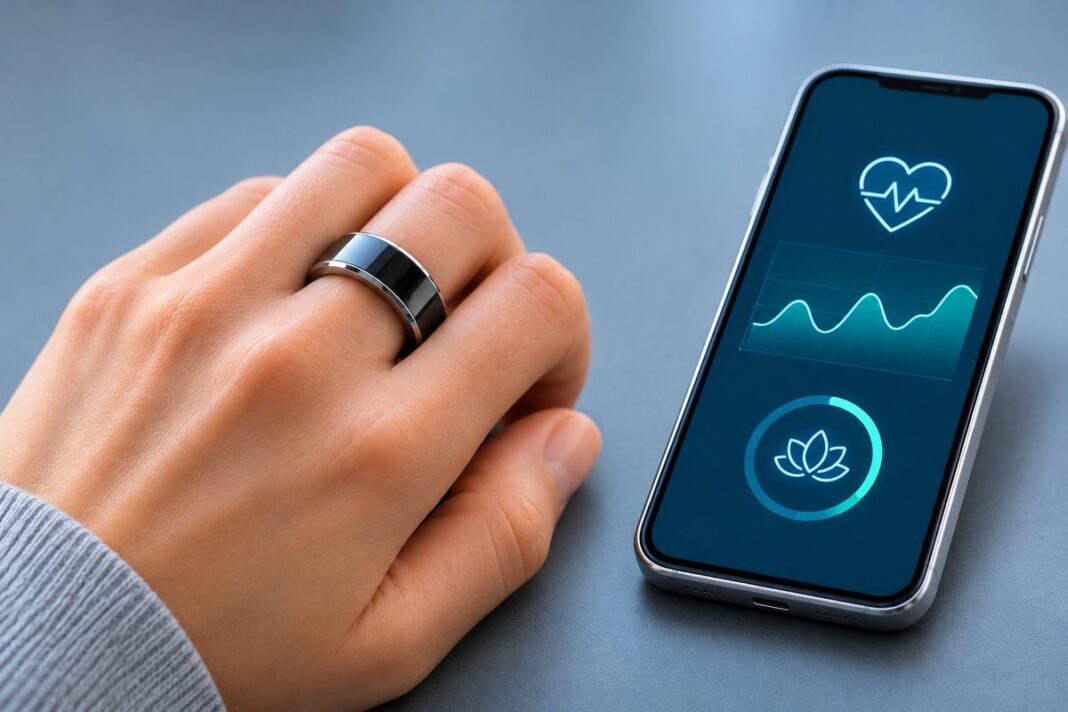
Researchers at the University of Southern California (USC) and the University of Maryland have developed an AI-powered wearable ring that uses optical sensing instead of conventional skin electrodes to monitor physiological responses associated with stress. The technology, described in a study published in Science Advances on 13 November 2026, introduces a sensing approach called optical sensing of dermal activity (ODA), designed to track sweat gland activation and support longer-term physiological monitoring.
Electrodermal activity (EDA) is widely used in wearable devices to monitor changes in skin conductance associated with sweat gland activity. However, conventional EDA sensors require direct electrical contact with the skin. Gel-based electrodes can deteriorate over time, contributing to baseline drift and reduced signal stability during prolonged monitoring.
An optical alternative to electrodermal activity sensing
To address these limitations, the researchers developed an optical system that measures changes in reflected light associated with perspiration dynamics.
The ODA sensor uses two wavelengths: 960 nm and 1250 nm. The first provides sensitivity to changes in skin water content associated with sweat gland activation, while the second serves as a reference channel for baseline correction.
The reflected optical signal also contains photoplethysmography (PPG) information. This allows the ring to derive additional cardiovascular parameters, including pulse rate and heart rate variability (HRV), without requiring a separate PPG sensor.
The wearable device integrates the optical components with a flexible four-layer printed circuit board, a microcontroller, a temperature sensor and a three-axis accelerometer. These additional measurements help the system account for physiological and movement-related variations.
Performance in experimental stress-monitoring tests
The researchers evaluated ODA against conventional EDA during experiments involving relaxation, cold-induced stress, recovery, physical movement and thermal sweating.
In physiological response comparisons, ODA and EDA signals demonstrated approximately 86% agreement.
In short-term classification experiments, the results depended on the sensor inputs and machine-learning model used. An ODA-based model achieved 79.45% binary classification accuracy, compared with 77.95% for the EDA-only model. When ODA was combined with additional physiological features, temperature and acceleration data, the multimodal model achieved 92.30% accuracy.
In a four-class classification task distinguishing relaxation, stress, physical movement and thermal sweating, the multimodal ODA model achieved 100% accuracy, compared with 74.58% for the EDA-only model.
The researchers also investigated performance during extended monitoring. Over three experimental sessions conducted within a 12-hour period, the gel-based EDA system showed substantial performance deterioration. The multimodal ODA model maintained 89.72% accuracy in four-class classification, compared with 43.20% for the EDA-based system. The researchers also reported 79.55% accuracy in binary classification for the multimodal ODA model.
These findings suggest that optical sensing combined with additional physiological measurements may offer advantages for prolonged monitoring. However, the results remain experimental and require validation in larger participant groups and under real-world conditions.
On-device AI processing
The ring incorporates an edge-AI architecture that performs physiological signal classification directly on its embedded microcontroller.
The processing pipeline uses a one-dimensional convolutional neural network (1D-CNN) and buffers 15 seconds of multimodal sensor data before standardisation and inference. The reported inference time is 32.7 milliseconds.
In the on-device evaluation, the system achieved 87.53% classification accuracy.
Local processing also reduces the need to transmit continuous raw sensor data. Instead, the device can transmit inferred mental-state classifications through Bluetooth Low Energy (BLE). The researchers report reduced data-transmission requirements and lower associated processing and communication overhead.
Potential applications in wearable medical technologies
The study presents ODA as an alternative optical sensing approach that could potentially be adapted for wearable rings, smartwatches and medical patches.
The technology may be relevant to the development of continuous physiological monitoring systems, particularly where long-term sensor stability, multimodal measurements and local data processing are important.
The authors also disclose a pending US provisional patent application covering the optodermal wearable technology, filed by the University of Southern California on 1 December 2025.
Although the experimental results are promising, further research will be needed to establish the technology’s reliability across larger populations and under a wider range of real-world conditions.
