


Russia’s human pharmaceutical manufacturing sector is subject to several layers of regulatory oversight, including manufacturing licensing, Eurasian Economic Union (EAEU) Good Manufacturing Practice (GMP) certification and domestic and foreign GMP inspections.
An analysis of three official Russian regulatory registers shows 490 manufacturing licence records, 3,286 GMP certificate records and 592 inspection register entries. The datasets provide complementary information on the scale of regulatory activity, certification status, refusal decisions and the distribution of GMP inspection findings.
The analysis is based on the Russian Ministry of Industry and Trade’s registers of pharmaceutical manufacturing licences, EAEU GMP certificates and GMP inspection results. The respective reporting periods and extraction dates are summarised in Section 9.
1. Scope and methodology
The analysis covers three distinct regulatory processes:
- Manufacturing licences: records of legal entities authorised to conduct pharmaceutical manufacturing activities and their registered manufacturing addresses.
- EAEU GMP certification: records of certificates issued, including entries reflecting subsequent changes in certificate status, as well as a separate register of refusal decisions.
- GMP inspections: records of planned and unscheduled inspections in Russia and inspections of foreign manufacturers.
These datasets represent different regulatory units and should not be combined into a single measure of the number of pharmaceutical manufacturers or manufacturing sites.
Licence holders, certificate records, refusal decisions and inspection reports are not interchangeable. One manufacturer may have multiple certificate records or manufacturing addresses.
Address-based comparisons can help identify potential overlaps between registers, but do not independently establish the legal identity or operational equivalence of manufacturing sites.
2. Pharmaceutical manufacturing licences
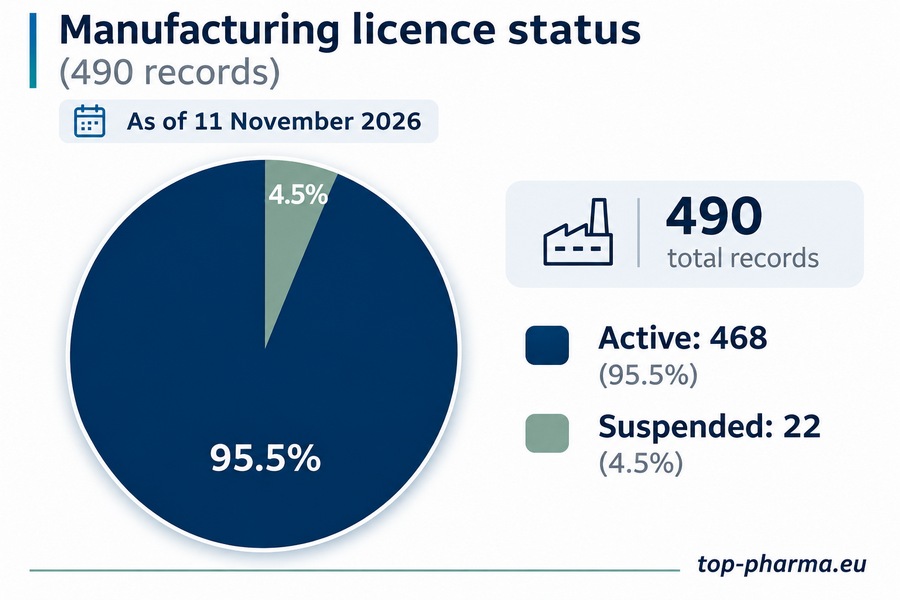
The Russian Register of Licences for the Manufacture of Medicinal Products contains 490 records. Of these, 468 licences are classified as active, while 22 are either fully or partially suspended.
 The register includes information on licence holders, legal addresses and addresses where licensed manufacturing activities may be carried out.
The number of licences should not be interpreted as the number of individual pharmaceutical manufacturing plants. A single licence holder may have several registered manufacturing addresses, while different legal entities may operate at the same or related sites.
3. EAEU GMP certification
The register of issued, revoked, suspended and terminated EAEU GMP certificates contains 3,286 records. Of these, 1,755 relate to manufacturers in Russia, representing approximately 53.4% of the total.
Among the Russian records, 1,014 are classified as active and 741 as inactive.
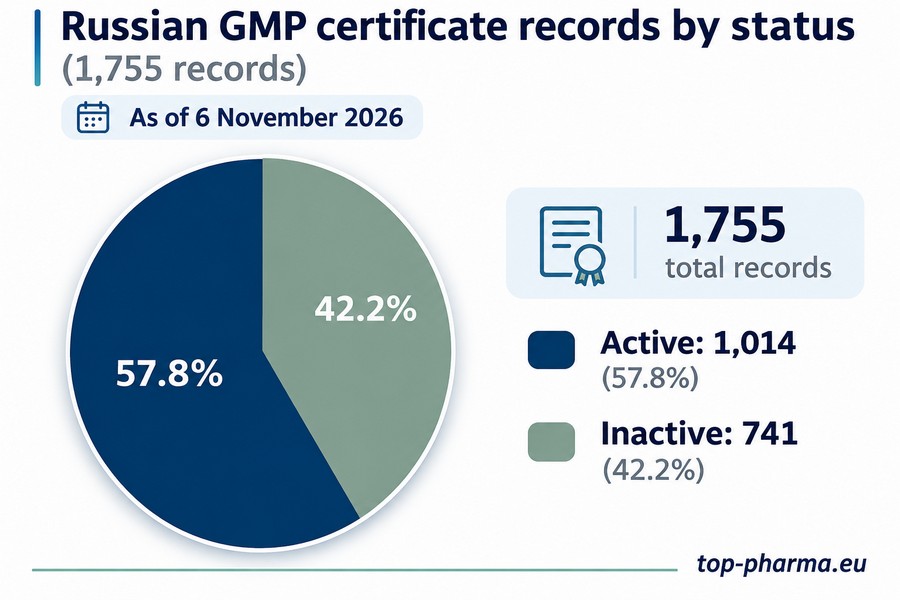 The figures reflect the status entries in the register. They should not be interpreted as the number of unique manufacturers, since the database contains certificate records associated with different certification events and subsequent status changes.
Dynamics of GMP certificate issuance
The number of Russian GMP certificate issuance records increased in 2024 and 2025. The register contains 437 issuance records for 2026 through 3 November.
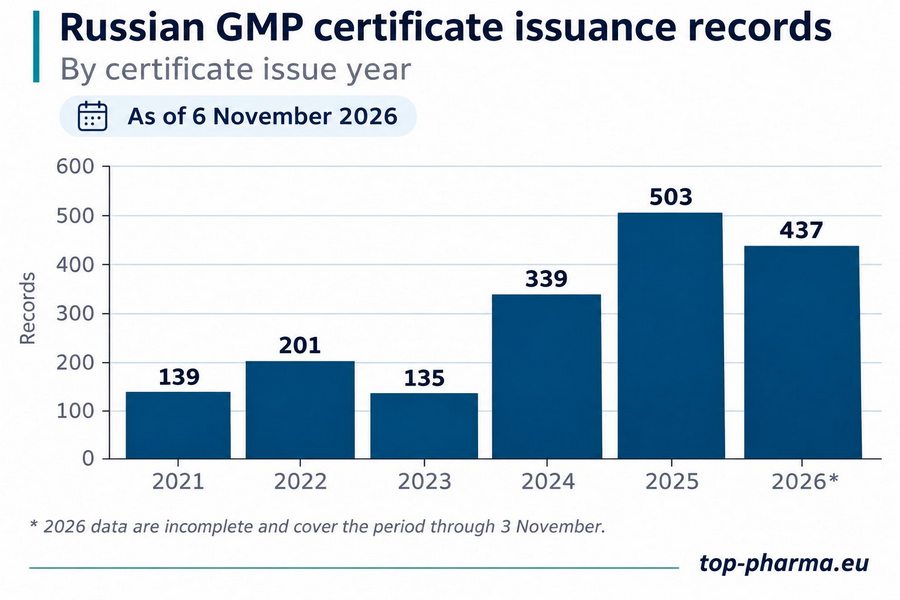
These figures represent entries in the certificate register, not necessarily the number of newly certified manufacturers. A manufacturer may appear more than once as a result of subsequent certification procedures or changes recorded in the database.
4. Decisions refusing GMP certificate issuance
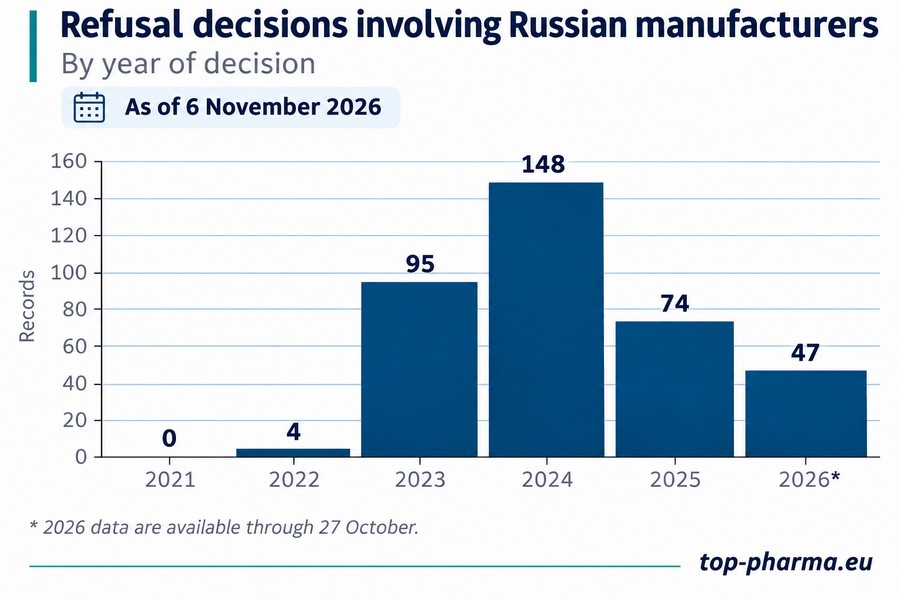
A separate register sheet, entitled “Refusal to Issue a Certificate”, contains 540 decisions. Of these, 368 concern Russian manufacturers.
The annual distribution of refusal decisions involving Russian manufacturers shows a concentration in 2023 and 2024, followed by lower recorded figures in 2025 and 2026.
The largest numbers of refusal decisions involving foreign manufacturers were recorded for India (41), Germany (21), France (19), the United States (11) and Italy (9).
Refusal decisions should be considered separately from certificates that were previously issued and subsequently revoked, suspended or terminated. These datasets describe different stages and outcomes of the certification process.
5. GMP inspections in Russia
The inspection register contains two groups of domestic GMP inspections recorded in 2026: 213 planned inspection entries and 158 unscheduled inspection entries. Together, these account for 371 domestic inspection register entries.
The number of entries should not automatically be interpreted as the number of unique manufacturing sites or manufacturers. A small number of report numbers occur more than once within the respective datasets.
Findings from planned and unscheduled inspections
The planned inspection records contain 1,584 deficiencies, while the unscheduled inspection records contain 308.
| Classification | Planned inspections | Unscheduled inspections |
|---|---|---|
| Critical | 44 | 4 |
| Substantial | 1,254 | 228 |
| Other | 286 | 76 |
| Total | 1,584 | 308 |
6. Foreign GMP inspections
The register contains 221 foreign GMP inspection entries. The geographical distribution shows that India and Germany account for the largest numbers, followed by France, the United States and Italy.
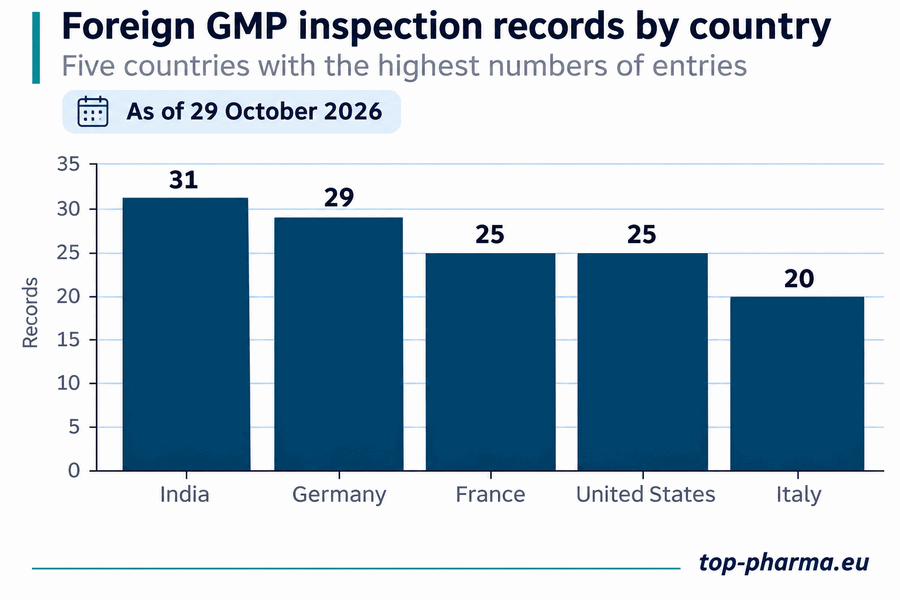
The figures indicate the geographical distribution of inspection activity recorded in the register. They do not, by themselves, measure the overall compliance level of pharmaceutical manufacturers in the respective countries.
Inspection outcomes
| Outcome | Records |
|---|---|
| Compliant | 176 |
| Under remediation | 36 |
| Non-compliant | 9 |
| Total | 221 |
7. Comparison of GMP deficiencies across inspection groups
Across the three inspection groups, the register contains 2,795 recorded deficiencies: 1,584 from planned inspections in Russia, 308 from unscheduled inspections in Russia and 903 from foreign inspections.
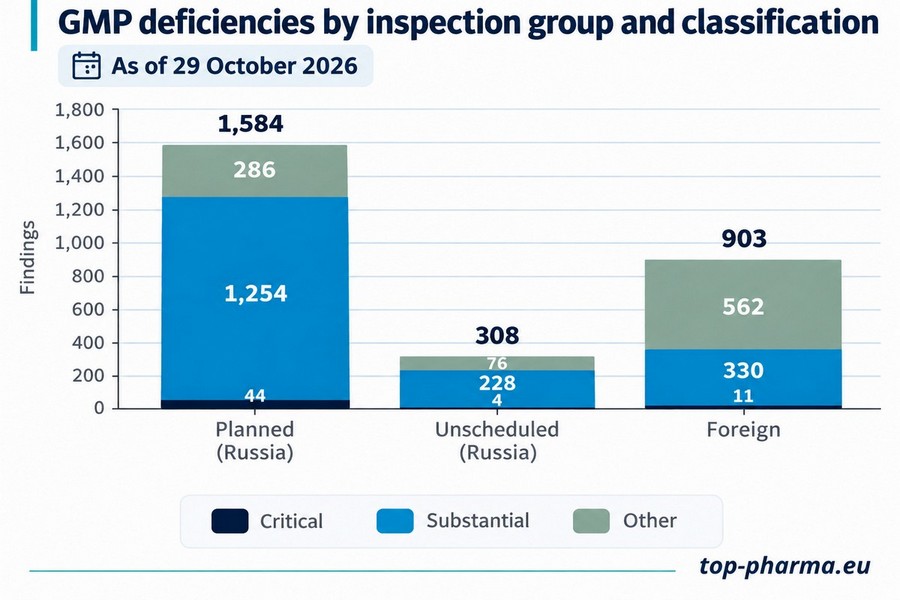 Across all three groups, substantial deficiencies account for the largest number of findings. The foreign inspection dataset has a different distribution: other findings outnumber substantial deficiencies.
Overall distribution of recorded GMP deficiencies
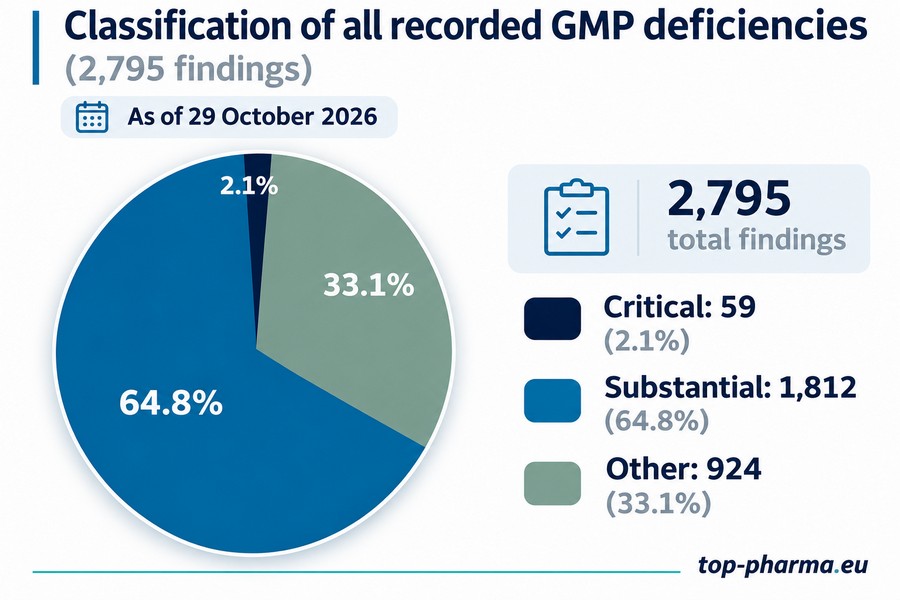
Critical findings account for approximately 2.1% of all recorded deficiencies. This percentage describes the classification of findings in the available inspection reports. It is not a measure of the probability of critical non-compliance at an individual manufacturing site.
8. What the combined registers show
Taken together, the three regulatory datasets provide complementary views of pharmaceutical manufacturing oversight in Russia.
| Regulatory dataset | Records | Key figures |
|---|---|---|
| Manufacturing licences | 490 | 468 active |
| EAEU GMP certificates | 3,286 | 1,755 Russian records |
| GMP certificate refusals | 540 | 368 involving Russian manufacturers |
| Planned domestic inspections | 213 | 1,584 deficiencies |
| Unscheduled domestic inspections | 158 | 308 deficiencies |
| Foreign GMP inspections | 221 | 903 deficiencies |
The datasets describe different regulatory procedures and reporting units. Their value lies in the complementary information they provide rather than in a single combined indicator of the size or compliance status of the pharmaceutical manufacturing sector.
9. Data currency and limitations
The analysis uses the supplied Ministry of Industry and Trade register extracts. Their reporting cut-off dates differ.
| Dataset | Coverage / latest available date |
|---|---|
| Manufacturing licence register | Extraction date not specified in the supplied file |
| GMP certificate issuance records | Through 3 November 2026 |
| GMP certificate refusal decisions | Through 27 October 2026 |
| Planned GMP inspections in Russia | 14 January – 1 October 2026 |
| Unscheduled GMP inspections in Russia | 15 January – 29 September 2026 |
| Foreign GMP inspections | 6 October 2025 – 1 October 2026 |
The certificate register contains entries with different status histories. Refusal decisions are held in a separate sheet and have been analysed independently. Address-based comparisons across registers are indicative only and do not establish legal or operational equivalence between records.
