

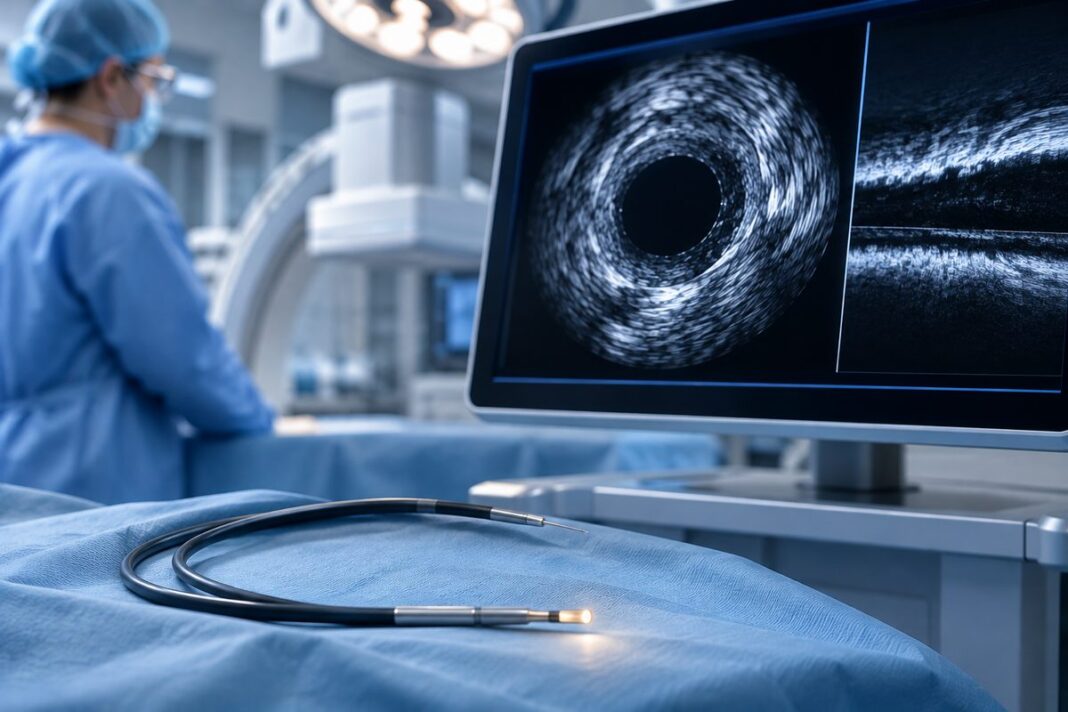
Evident Vascular has received U.S. Food and Drug Administration (FDA) 510(k) clearance for its Evident Vascular Guidance System (EVGS), an intravascular ultrasound (IVUS) platform designed for peripheral vascular interventions. The system combines high-resolution ultrasound imaging, proprietary image-processing technology and computing capabilities powered by NVIDIA.
The FDA issued its substantial equivalence determination on 28 October 2026 under submission K261648. The device is classified as Class II and was found substantially equivalent to the previously cleared iLab Polaris Multi-Modality Guidance System (K210889).
The EVGS is intended for ultrasound examination of intravascular pathology in patients who are candidates for transluminal interventions such as angioplasty and atherectomy. The accompanying Evident Peripheral Imaging Catheters are intended specifically for ultrasound examination of peripheral vascular pathology.
Imaging architecture and NVIDIA technologies
According to Evident Vascular, the platform combines custom imaging electronics with real-time image processing using NVIDIA accelerated computing. Its imaging architecture integrates a broad frequency bandwidth, advanced transducer design and the company’s proprietary Dynamic Frequency Control (DFC) technology.
The company’s DFC technology is designed to dynamically adjust imaging frequency, optimising resolution and penetration across different vessel sizes and imaging depths. The system is designed to provide detailed intravascular images during peripheral vascular procedures.
The platform includes a workstation, dedicated software, a catheter interface module and a tablet-based user interface. It also supports touchscreen operation and optional hands-free voice control.
Evident Vascular is a member of the NVIDIA Inception programme, which supports start-ups developing technologies in artificial intelligence and advanced computing.
AI capabilities and planned development
The company describes EVGS as an AI-enabled imaging platform designed to bring artificial intelligence capabilities directly to the point of care.
According to Evident Vascular, its proprietary AI workstation and software architecture provide a foundation for expanding these capabilities as clinical experience and imaging data accumulate. The company plans to introduce additional software features aimed at improving image interpretation, procedural workflows and the overall user experience.
These planned developments represent the company’s longer-term technology strategy. The FDA’s 510(k) determination itself establishes substantial equivalence for the submitted device and does not constitute a separate regulatory assessment of the platform’s AI capabilities.
FDA assessment and technical limitations
The 510(k) submission included non-clinical performance and safety testing covering software verification and validation, electrical safety, electromagnetic compatibility, biocompatibility, acoustic output, human factors and cybersecurity.
The FDA’s review was based on substantial equivalence to the predicate device, the iLab Polaris Multi-Modality Guidance System. The submission’s summary states that the EVGS shares the same fundamental IVUS imaging modality and intended diagnostic purpose.
However, the new system does not include some functions available in the predicate device, including fractional flow reserve (FFR), diastolic hyperemia-free ratio (DFR) and automatic pullback functionality. Its peripheral imaging catheters are also limited to examination of peripheral vascular pathology.
Clinical performance testing was not conducted as part of the 510(k) submission. The regulatory determination therefore does not establish clinical superiority or demonstrate improved patient outcomes compared with existing IVUS systems.
Despite receiving FDA clearance, the EVGS and its peripheral imaging catheters were not yet commercially available in the United States or other markets as of 4 November 2026, according to the company.
