

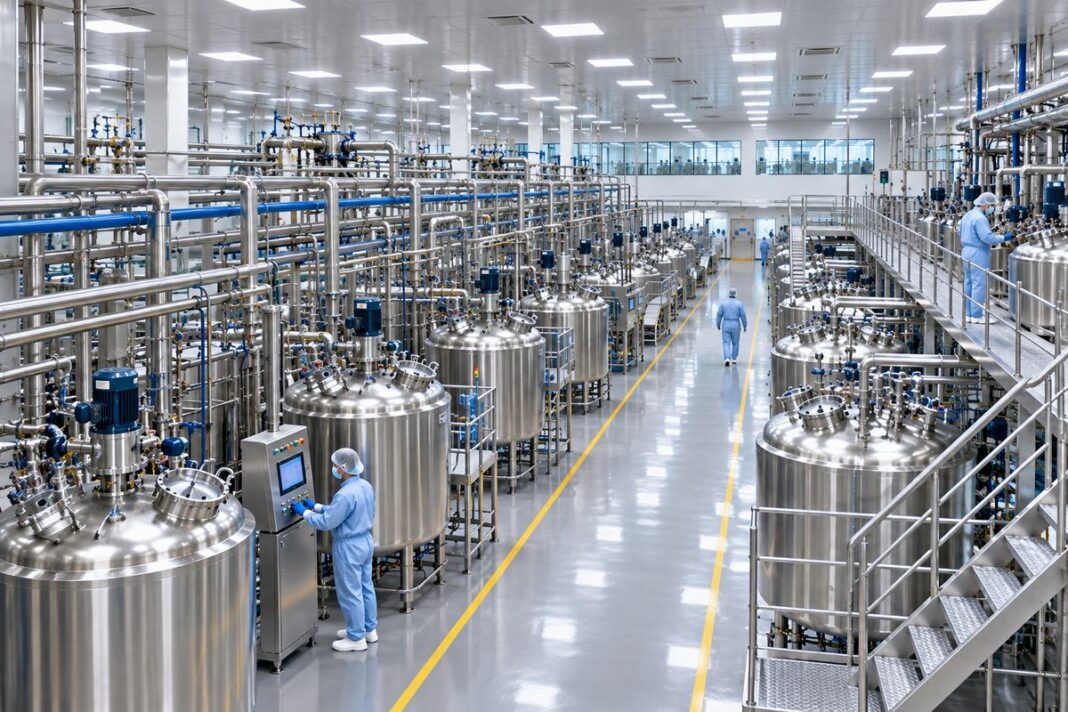
The rapid growth of the GLP-1 drug market is driving a major expansion of global peptide manufacturing capacity. Pharmaceutical companies are investing in their own production networks, while contract development and manufacturing organisations (CDMOs) are building new facilities, acquiring specialist manufacturers and upgrading existing sites.
Not all announced projects are dedicated exclusively to GLP-1 medicines. Several investments concern broader peptide manufacturing platforms that may also support GLP-1-related programmes, depending on customer demand, process requirements and available capacity.
The investment pipeline spans North America, Europe and Asia. It includes large-scale peptide active pharmaceutical ingredient (API) facilities, new synthesis reactors, purification infrastructure and downstream manufacturing capabilities. However, these projects do not represent a single pool of immediately available capacity. Some are designed primarily to supply originators’ own medicines, while independent CDMOs serve external customers. Their manufacturing scope, technology and operational timelines also differ considerably.
Originator investments: expanding captive manufacturing
Eli Lilly and Novo Nordisk account for a substantial share of announced investment in GLP-1-related manufacturing infrastructure.
Eli Lilly has committed $9 billion to its manufacturing campus in Lebanon, Indiana, which includes production of tirzepatide API for Mounjaro and Zepbound. Production was initially expected to begin towards the end of 2026, with operations scaling up through 2028.
The company has also announced more than $6 billion for a new manufacturing site in Huntsville, Alabama, covering API production for small-molecule and peptide medicines, and more than $3.5 billion for a facility in Lehigh Valley, Pennsylvania, focused on injectable medicines and devices. These projects have different manufacturing purposes and timelines: the Huntsville facility is expected to be completed in 2032, while Lehigh Valley is scheduled to become operational in 2031.
Novo Nordisk announced an investment exceeding DKK 42 billion in its Kalundborg manufacturing facilities in Denmark. The programme includes a major expansion of API production, alongside other manufacturing and packaging operations. The site is intended to support multiple products, including GLP-1 medicines, rather than a single dedicated API.
Novo has also expanded its downstream manufacturing network through investments in the United States and the acquisition of Catalent filling facilities in Italy, Belgium and the United States. These projects strengthen sterile filling capacity, but should not be counted as peptide API synthesis capacity.
Independent CDMOs: expanding commercial peptide capacity
Specialist peptide manufacturers are investing in facilities intended to serve multiple pharmaceutical and biotechnology customers.
Bachem is expanding its Swiss manufacturing network. Its Building K facility in Bubendorf entered operation in 2026 and is already manufacturing commercial GMP products. Separately, the company announced an investment of more than CHF 500 million in the first phase of its Sisslerfeld project in Eiken. Commercial production at the new site is expected in 2030.
CordenPharma is pursuing a multi-site expansion strategy. Its greenfield peptide facility in Muttenz, Switzerland, represents an investment exceeding €500 million, within a broader programme of more than €1 billion. Commercial activity is expected to begin in the first half of 2028.
In the United States, the acquisition of AmbioPharm added manufacturing operations in North Augusta, South Carolina, and Shanghai, China, to CordenPharma’s network. A further expansion at the South Carolina site will add commercial peptide API capabilities using solid-phase peptide synthesis (SPPS), liquid-phase peptide synthesis (LPPS) and hybrid routes. Operations are expected to begin by the end of 2027.
PolyPeptide reported revenue of €236.6 million in the first half of 2026, an increase of 41.6% year on year. Revenue from metabolic therapeutics rose by 72.7% and accounted for 68.4% of total revenue. Its large-scale SPPS facility in Braine-l’Alleud, Belgium, had reached its target utilisation rate. Further expansion includes commissioning work in Malmö, Sweden, and a production ramp-up in Strasbourg, France.
PolyPeptide is also the subject of a public takeover offer by Samsung Biologics through Samsung Peptide AG. The tender offer attracted 97.66% of PolyPeptide’s issued share capital and voting rights, following the end of the additional acceptance period on 30 October 2026. However, the acquisition has not yet been completed, as regulatory approvals remain outstanding. Settlement, originally scheduled for 13 November, has been postponed, with completion currently expected towards the end of 2026 or in the first quarter of 2027.
The acquisition would give Samsung access to an established peptide CDMO network rather than represent the construction of an entirely new manufacturing platform.
SK pharmteco announced a five-year investment programme exceeding $200 million to expand its US development and manufacturing infrastructure. The programme includes GMP kilo-scale peptide manufacturing and additional purification capabilities. The investment covers both small molecules and peptides, and the company indicated that new peptide capacity was scheduled to become operational in late 2026.
Asia: large-scale synthesis and new commercial facilities
Asia is becoming an increasingly important centre for peptide manufacturing investment, with major projects in China and India.
China-based WuXi AppTec, through WuXi STA, completed its peptide manufacturing plant in Taixing in September 2025. Across its manufacturing network, the company reported more than 100,000 litres of SPPS reactor volume, making it the largest disclosed SPPS capacity among the CDMO projects included in the October 2026 industry tracker.
Asymchem reported more than 45,000 litres of SPPS reactor volume at its TJ4 site in Tianjin, supporting company-reported annual peptide production capacity exceeding 22.5 metric tonnes. The company announced plans to increase total SPPS reactor volume to approximately 69,000 litres by the end of 2026. Its integrated TIDES platform also includes downstream capabilities such as prefilled syringe and cartridge manufacturing.
In India, Neuland Laboratories commissioned the first commercial peptide manufacturing module at its Bonthapally site near Hyderabad in September 2026. The module has a reported total reactor volume of 7,000 litres, comprising 6,250 litres of LPPS capacity and 750 litres of SPPS capacity. The company has outlined plans for further modules, including a larger second module.
Sai Life Sciences is developing a greenfield commercial peptide API facility near Hyderabad. The company has indicated an investment of less than INR 300 crore through 2028, with operations expected to begin in that year.
Granules India, through its peptide CDMO business Senn Tides, is also expanding its presence. Its manufacturing platform combines LPPS capabilities at its Swiss site with SPPS and hybrid synthesis capabilities in Switzerland and India. The company has indicated that a significant share of its planned group capital expenditure of approximately INR 2,000 crore over three to four years will support this business.
Key companies expanding peptide manufacturing capacity
| Company | Headquarters | Key locations | Manufacturing focus | Project status |
|---|---|---|---|---|
| Eli Lilly | USA | Indiana, Alabama, Pennsylvania | Peptide API, including tirzepatide; injectable medicines | Multiple projects under development |
| Novo Nordisk | Denmark | Denmark, USA, Italy, Belgium | API production and sterile filling | Multi-site expansion; filling network expanded |
| Bachem | Switzerland | Switzerland, USA | Commercial peptide API; large-scale synthesis | Building K operational; Sisslerfeld planned |
| CordenPharma | Germany | Switzerland, USA, China, Italy | Peptide API; SPPS, LPPS and hybrid synthesis; fill-finish | Muttenz under construction; US expansion under way |
| PolyPeptide | Switzerland | Belgium, Sweden, France, India, USA | Peptide API and development services | Commercial expansion and commissioning |
| SK pharmteco | USA | USA, South Korea | Peptide API and small-molecule manufacturing | New GMP peptide capacity planned |
| WuXi AppTec (WuXi STA) | China | China | Large-scale SPPS peptide API | More than 100,000 L SPPS reactor volume reported |
| Asymchem | China | China | Peptide API; integrated TIDES platform | Expanded SPPS capacity commissioned; further expansion planned |
| Neuland Laboratories | India | India | Peptide API; SPPS and LPPS | First 7,000 L module commissioned |
| Sai Life Sciences | India | India | Commercial peptide API | Greenfield facility planned for 2028 |
| Granules India (Senn Tides) | India | Switzerland, India | Peptide API; LPPS, SPPS and hybrid synthesis | Manufacturing expansion under way |
Reactor volume is not the same as annual output
The published figures illustrate the scale of investment, but comparisons require care. Reactor volume, annual production capacity and actual commercial output are different measures.
WuXi AppTec’s reported SPPS reactor volume exceeds 100,000 litres, while Asymchem has disclosed more than 45,000 litres at its Tianjin site. CordenPharma is also expanding its Boulder, Colorado, operations with total SPPS reactor volume expected to exceed 42,000 litres by 2028. Neuland’s first commercial module in India has a total reactor volume of 7,000 litres, most of it allocated to LPPS.
These figures cannot be directly converted into comparable annual API output. Production depends on synthesis route, process duration, batch size, purification, yields, product complexity and facility utilisation. The distinction is particularly important when comparing SPPS and LPPS platforms.
Capacity growth does not mean immediate market availability
The current investment cycle is reshaping the global peptide manufacturing landscape. Originators are strengthening captive production networks, while independent CDMOs are expanding their commercial platforms and geographic reach. Acquisitions, greenfield projects and upgrades of existing facilities are contributing to this expansion in different ways.
However, the announced pipeline should not be confused with immediately available supply. Some facilities are already manufacturing commercial GMP material; others are still being commissioned, constructed or planned for the end of the decade. Their ability to support new customer programmes will also depend on process qualification, regulatory compliance, technology transfer and available production slots.
Regulatory compliance also affects whether manufacturing capacity can serve particular markets. For example, the regulatory status of a manufacturing site, the outcome of inspections and any import restrictions may determine whether its products can be supplied to the United States or other regulated markets. Consequently, announced reactor capacity does not necessarily translate into immediately accessible supply for every customer or market.
For the GLP-1 market, the key question is therefore not simply how much new capacity is being announced, but how much qualified peptide API manufacturing capacity will become commercially available, where it will be located and which customers will be able to access it.
Sources
Industry overview
- Peptide & Protein — Peptide CDMOs and GLP-1 Manufacturing Capacity: Every Announced Plant and Investment (21 October 2026)
- Eli Lilly — Lebanon manufacturing investment
- Eli Lilly — Huntsville manufacturing site
- Eli Lilly — Lehigh Valley manufacturing site
- Novo Nordisk — Kalundborg manufacturing investment
- Bachem — Sisslerfeld investment
- Bachem — H1 2026 results
- CordenPharma — Muttenz peptide facility
- CordenPharma — North Augusta expansion
- PolyPeptide — H1 2026 Business Review
- SK pharmteco — US investment programme
- Asymchem — Integrated TIDES manufacturing platform
- Neuland Laboratories — Commercial peptide manufacturing expansion
- Granules India — Peptide investment and Senn Tides
