

Basic Principles for the Use of AI in Regulatory Activities (Early Consideration)
Document type: Regulatory principles.
Publication date: 2 November 2026.
Effective date: Not applicable — non-binding reference document.
Status: Early Consideration.
Format: PDF document.
Language: English provisional translation; the Japanese original prevails in the event of any inconsistency.
Summary
The Pharmaceuticals and Medical Devices Agency (PMDA) has issued Basic Principles for the Use of AI in Regulatory Activities (Early Consideration) through its Center for Regulatory Science. Published on 2 November 2026, the document sets out an early reference framework for the responsible use of artificial intelligence in activities involving regulatory judgement and decision-making. It is intended to support consideration of how AI may be used in a way that protects patients and the public while maintaining appropriate human responsibility.
The principles cover regulatory activities across the lifecycle of pharmaceuticals, quasi-drugs, cosmetics, medical devices and regenerative medical products. Their scope includes activities from non-clinical and clinical studies through manufacturing and post-marketing stages. The document is intended for a broad range of stakeholders, including PMDA, applicants, marketing authorisation holders, manufacturers, sponsors, contract research organisations and developers and providers of AI systems. Basic research and general medical practice are not identified as being among its primary focus areas.
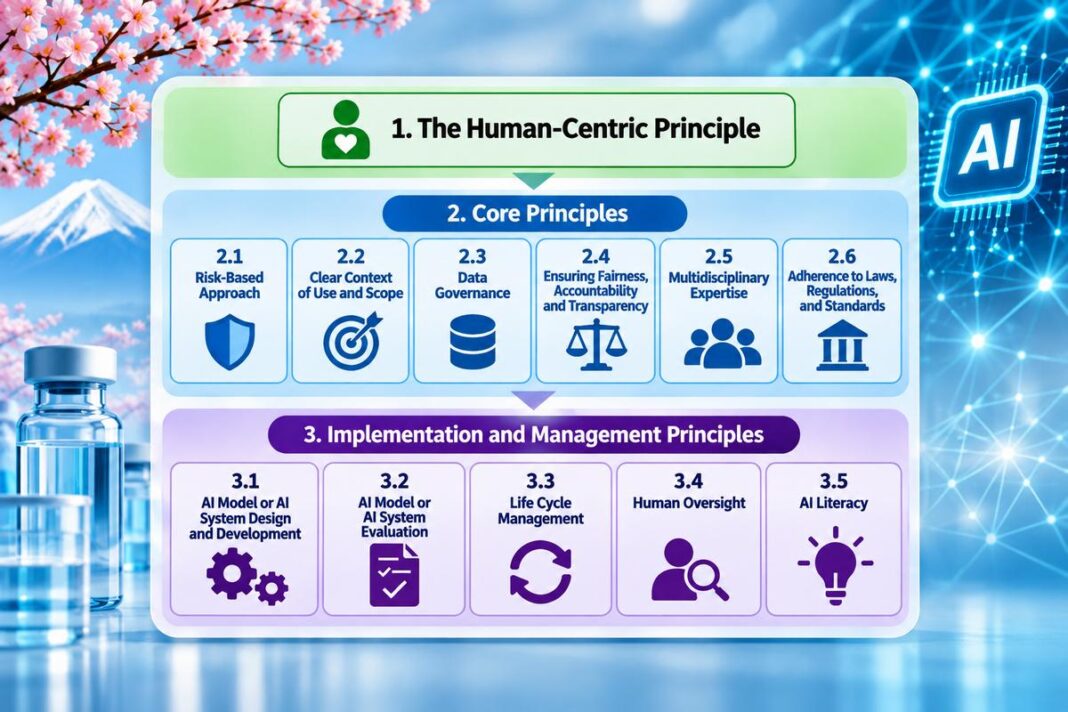
The framework is structured around one overarching Human-Centric Principle, six Core Principles and five Implementation and Management Principles. The human-centric principle positions AI as a means of supporting, rather than replacing, human judgement, with ultimate responsibility remaining with people. The six core principles address a risk-based approach; a clearly defined context and scope of use; data governance; fairness, accountability and transparency; multidisciplinary expertise; and compliance with applicable laws, regulations and standards.
The five implementation and management principles address AI model and system design and development, evaluation, lifecycle management, human oversight and AI literacy. The document highlights the importance of evaluating AI in the environment in which it will actually be used, rather than relying only on technical performance measures. It also emphasises the appropriate management of data sources, data characteristics, processing steps, change histories and traceability, alongside continuous monitoring and periodic reviews after deployment.
The publication is an early, non-binding reference document and does not establish new regulatory requirements. It should not be treated as a new GMP guideline or as introducing additional GMP obligations. PMDA indicates that the principles may be reviewed and updated in response to technological developments, practical experience and international developments. The English text is a provisional translation; the Japanese original takes precedence if the two versions differ.
