

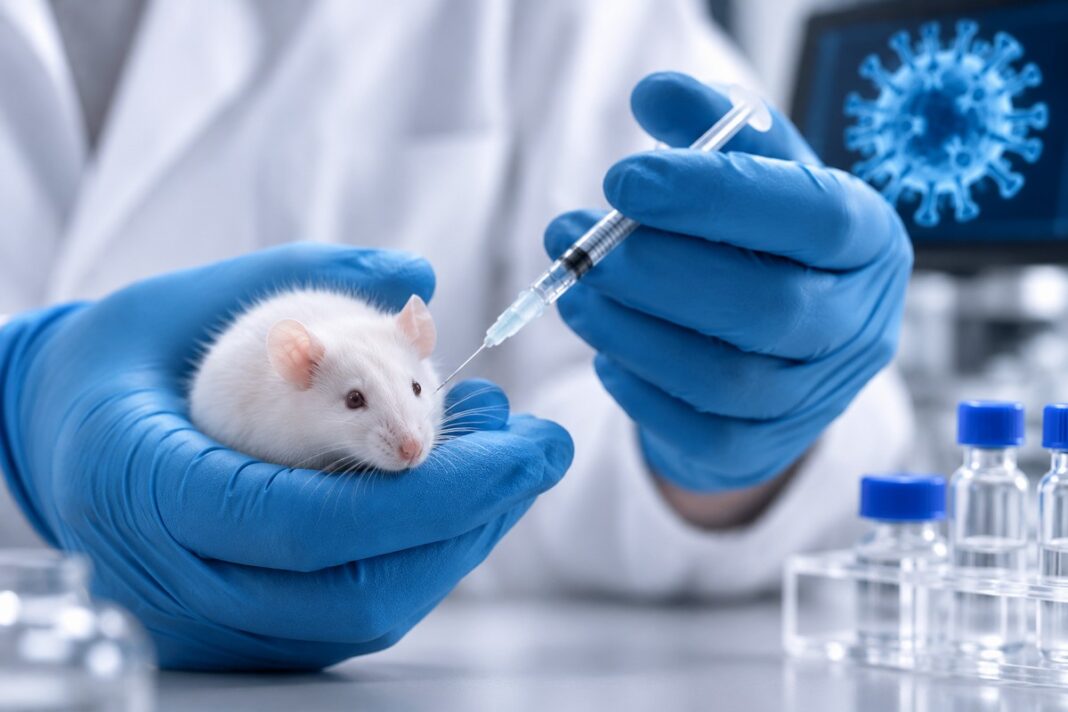
Researchers at the University of Cambridge and its spin-out company DIOSynVax Ltd have developed a computationally designed mRNA vaccine that provided broad protection against antigenically diverse avian influenza A/H5N1 viruses in preclinical studies. The candidate, designated DVX-panH5Nx, demonstrated protection in mouse and ferret challenge models, including against viral strains representing more than two decades of evolution.
The findings were published online in Cell Reports Medicine on 5 November 2026.
Computational design of multiple viral antigens
Unlike conventional H5 influenza vaccines, which typically rely on a single haemagglutinin (HA) antigen, the new approach combines computationally engineered versions of three viral proteins: haemagglutinin (HA), neuraminidase (NA) and matrix protein 2 (M2).
The researchers used computational modelling to design antigens representing the global antigenic diversity of circulating H5Nx viruses. Particular attention was given to the N1 and N6 neuraminidase subtypes, which are associated with significant risks to human health.
The resulting DVX-panH5Nx candidate is an mRNA vaccine formulated to induce immune responses against multiple viral components. The vaccine combines antigens with complementary functions, including HA-mediated viral entry neutralisation, NA-mediated restriction of viral egress and M2-mediated immune potentiation.
Protection against divergent H5N1 strains in mice
The vaccine was evaluated in mouse challenge studies involving three antigenically distinct H5N1 viruses:
- A/Vietnam/1203/2004, representing clade 1;
- A/Cambodia/NPH230032/2023, representing clade 2.3.2.1e;
- A/British Columbia/PHL-2032/2024, representing clade 2.3.4.4b.
Mice receiving DVX-panH5Nx achieved 100% survival following lethal challenge with all three viruses. The vaccinated animals also showed no significant weight loss or clinical signs of disease.
In comparison, an inactivated vaccine based on a WHO candidate vaccine virus (CVV), A/Astrakhan/3212/2020 (H5N8), provided survival rates of 50% against the clade 1 challenge and 67% against clade 2.3.2.1e. Protection against the antigenically matched clade 2.3.4.4b challenge was 100%.
Viral titres in the lungs and spleens of DVX-panH5Nx-vaccinated mice were below the detection limit four days after challenge.
Results in ferrets and a lower-dose formulation
The researchers also evaluated the vaccine in ferrets, an established animal model for influenza research.
Following challenge with A/chicken/Italy/23VIR3799-1/2023 (H5N1), representing clade 2.3.4.4b, five of the six animals receiving the standard DVX-panH5Nx formulation survived the observation period. In a separate group receiving the lower-dose formulation DVX-panH5Nx_FML2, all eight ferrets survived.
By comparison, only 50% of ferrets receiving the adjuvanted inactivated H5N1 vaccine based on the corresponding H5N8 candidate survived. All unvaccinated control animals reached the humane endpoint or succumbed to infection.
The results also demonstrated broad haemagglutinin-neutralising and neuraminidase-inhibiting antibody responses across divergent viral lineages.
International collaboration and next development steps
The study was led by Dr Joanne Marie M. Del Rosario and Professor Jonathan L. Heeney, Professor of Research in Vaccinology at the University of Cambridge and founder of DIOSynVax.
The international research collaboration involved DIOSynVax, the University of Cambridge, the Public Health Agency of Canada’s National Microbiology Laboratory, Italy’s Istituto Zooprofilattico Sperimentale delle Venezie, the University of Regensburg, the University of Nottingham and other research partners.
Several authors, including Jonathan L. Heeney, are employees or shareholders of DIOSynVax Ltd, as disclosed in the research paper.
The findings support further development of computationally designed multivalent vaccines as a potential strategy for addressing the antigenic diversity of rapidly evolving influenza viruses.
The candidate remains at the preclinical stage. According to the University of Cambridge, human clinical trials are the next intended step in its development.
The researchers note that the comparison between the mRNA-LNP candidate and the whole-inactivated vaccine does not fully distinguish the effects of antigen design from those of the vaccine platform. Differences in formulation, antigen dose and immune activation may also have contributed to the observed results.
